Research · 2026 · AI Incident Commander
Multi-agent LLMs bought robustness, not reasoning
A fair test on two models, then four follow-up experiments. A pre-registered, equal-budget comparison of a multi-agent incident-diagnosis system against a single agent on 45 held-out microservice incidents. Updated 19 October 2026 with the follow-up experiments; the first single-model post was Same accuracy, 3.4× the cost.
TL;DR
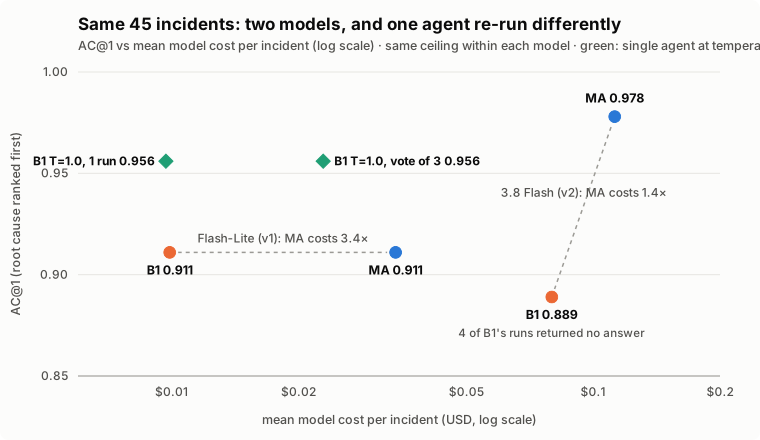
- With a fast, cheap model, a multi-agent system (three concurrent specialists, a coordinator, a critic) found the root cause exactly as often as one well-built agent: 41 of 45 incidents each, at 3.4× the cost.
- With a stronger, slower thinking model, the multi-agent system came out ahead, 0.978 vs 0.889, but every case it won was one where the single agent returned no answer at all (out of time, throttled, unparseable output).
- Four follow-up experiments then asked why. Re-running the single agent differently (sampling at temperature 1.0, rewording its prompt, or renaming every service) fixed the same errors the multi-agent system had seemed to correct. A single agent sampled three times and voted reached 0.956, above the multi-agent system’s 0.911, at two-thirds of its cost.
- Where coordination did pay off: stability (under the same rewording, the multi-agent system’s answers changed on 1 case, the single agent’s on 4) and robustness to timeouts on a slow model. And the best “I might be wrong” signal was free: when three differently worded runs of the single agent agreed (89 % of incidents), it was right every time.
- Recommendation: before building a multi-agent system, perturb and vote a single agent. The whole study, three frozen experiments and roughly 600 held-out runs, cost $33 in model calls.
The question
Multi-agent architectures are the default answer in agent design: give each data source its own specialist, add a coordinator, add a critic, and the system should reason better than one model alone. Most published comparisons, though, let the team of agents spend more, see more or get tuned more than the single agent it is compared with.
I wanted a fair answer, so I built both systems and tested them the way you would test a treatment: the same inputs, the same budget ceiling, an analysis plan written before the results, a frozen protocol, and a held-out set nobody had looked at.
The task. When a microservice application degrades, the alert fires on a symptom (a slow checkout page) while the cause is often several calls away. The benchmark is RCAEval RE2: two open-source applications (Online Boutique, Train Ticket) with six kinds of injected faults. Given the telemetry (metrics, logs, traces) and the alert time, rank the services most likely to be the root cause. The metric is AC@1: how often the true cause is ranked first.
The two systems, built on the same model, the same seven read-only telemetry tools, the same deterministic anomaly digest and the same per-incident ceiling:
- Single agent (B1): one tool-using loop that investigates and submits a ranked diagnosis with cited evidence.
- Multi-agent (MA): a Commander plans; metrics, logs and traces specialists investigate concurrently in separate contexts; deterministic checks and a Skeptic challenge the leading theory; the Commander adjudicates, may ask one targeted follow-up, and ranks.
Every claim either system makes must cite an observation that a validator checks, so neither can win by inventing evidence. Two baselines with no LLM at all run on every case: one ranks services straight from the anomaly digest (D1), the other is the benchmark’s own BARO method (D0).
Result 1: with a fast model, a tie at 3.4× the cost
Model: gemini-3.1-flash-lite. Ceiling: $0.33 and 24 model calls per incident, for both systems.
| D0 (no model) | D1 (digest only) | Single agent | Multi-agent | |
|---|---|---|---|---|
| AC@1 | 0.40 | 0.76 | 0.911 | 0.911 |
| Mean cost per incident | — | — | $0.0099 | $0.0340 |
| Mean wall time | — | — | 14 s | 18 s |
The pre-registered estimate of the difference is 0.0 points, 95 % interval −8.9 to +8.9. Both systems got the same 39 incidents right and the same 2 wrong; the other 4 split 2–2.
The failure analysis (two independent annotators, rules written before any failure was read) suggested a tidy story: the single agent’s distinctive errors were reading errors inside one long context (a database blamed for its own service; the right service found, then a later distraction promoted), which three voting specialists would correct; the multi-agent system’s distinctive errors were coordination errors (a follow-up round overriding a correct answer). Two kinds of mistakes, cancelling out. Result 3 shows that story was only half right.
Result 2: with a stronger model, the multi-agent system wins, for an unexpected reason
The obvious objection to Result 1 is “that’s a small model”. So I re-ran the experiment with gemini-3.8-flash, a
stronger model that thinks before it answers, on the same 45 incidents, with the same system and an analysis plan
fixed before the run. Only limits that had to scale with the model changed, identically for both systems: the cost
ceiling ($1.00, because the model is about 3× the price) and the time limits (it is much slower).
| Single agent | Multi-agent | |
|---|---|---|
| AC@1 | 0.889 | 0.978 |
| Mean cost per incident | $0.080 | $0.113 (1.4×) |
| Difference in AC@1 | +8.9 points (95 % interval +2.2 to +17.8) |
The multi-agent system got 4 incidents right that the single agent missed, and none the other way round. All four were single-agent runs that ended with no answer: one throttled by the API on its first call, two that ran past the 30-minute limit after 12 and 18 sequential calls, one that produced malformed output twice. On every incident where the single agent produced a ranking, it was right. The multi-agent system’s specialists run in parallel, so it finishes sooner on a slow model, and when one of its steps fails the coordinator still falls back to the specialists’ vote.
This run is exploratory: the cases had already been used once, and part of the gap is a design gap in the control (the single agent forces a final answer near its call budget, not near its time limit). The honest summary: coordination bought robustness, not reasoning.
Result 3: four follow-up experiments on why the first result tied
A tie invites four questions, so I ran four experiments, all on the fast model and the same 45 incidents, all pre-registered and frozen before any run, under a $7 cap (405 runs, $5.55, every run produced a ranking).
First, a correction. Earlier I wrote that the model was “deterministic”: repeated runs never changed an answer. That was true, but only because the model layer fixed the temperature at 0. It is a property of the configuration, not of the model. These experiments made temperature a per-arm setting.
A. Is it coordination, or just more samples?
If the multi-agent system’s advantage on the single agent’s errors comes from having several attempts, sampling the single agent should reproduce it.
| AC@1 | Mean $ per incident | |
|---|---|---|
| Single agent, temperature 0 (Result 1) | 0.911 | 0.0099 |
| Multi-agent (Result 1) | 0.911 | 0.0340 |
| Single agent, temperature 1.0, one run | 0.956 | 0.0097 |
| Single agent, temperature 1.0, majority vote of 3 | 0.956 | 0.0229 |
The vote of three beat the multi-agent system by 4.4 points (interval 0.0 to +11.1) at two-thirds of its spend. By the pre-registered rule, the error correction attributed to coordination is reproducible by sampling at equal spend. The mechanism, though, is not the vote: the three samples agreed on 43 of 45 incidents, and a single temperature-1.0 run already scored 0.956. What fixed the errors was running differently at all.
B. Is it memorizing these public demo apps?
Online Boutique and Train Ticket are on GitHub, so a model could have seen them. I replaced every service name with an opaque code, in metrics, logs, traces, tool arguments and free text, verified by a leak test, and re-ran both systems.
| Original names | Names hidden | |
|---|---|---|
| Single agent AC@1 | 0.911 | 0.956 |
| Multi-agent AC@1 | 0.911 | 0.933 |
Neither system lost accuracy. A pre-registered control (the digest-only baseline, which never reads names) gave
identical results on renamed data in all 45 cases, so the renaming itself is clean. On these cases, neither system is
leaning on prior knowledge of the apps. One side effect is visible: renaming removes type hints like -mongo, and the
single agent’s database-for-service confusion disappeared.
C. Does prompt wording matter more than architecture?
I reworded every prompt, lightly and heavily, keeping the same rules, and re-ran both systems.
| Original wording | Heavy rewording | Top-1 answers changed by that rewording | |
|---|---|---|---|
| Single agent | 0.911 | 0.933 | 4 of 45 |
| Multi-agent | 0.911 | 0.933 | 1 of 45 |
The gap between the two systems is 0.0 points under both wordings: the tie is robust to how the prompts are phrased. But the same rewording changed the single agent’s answer on four times as many incidents. That is a real benefit of coordination the accuracy number hides: stability.
D. Can either system tell when it is wrong?
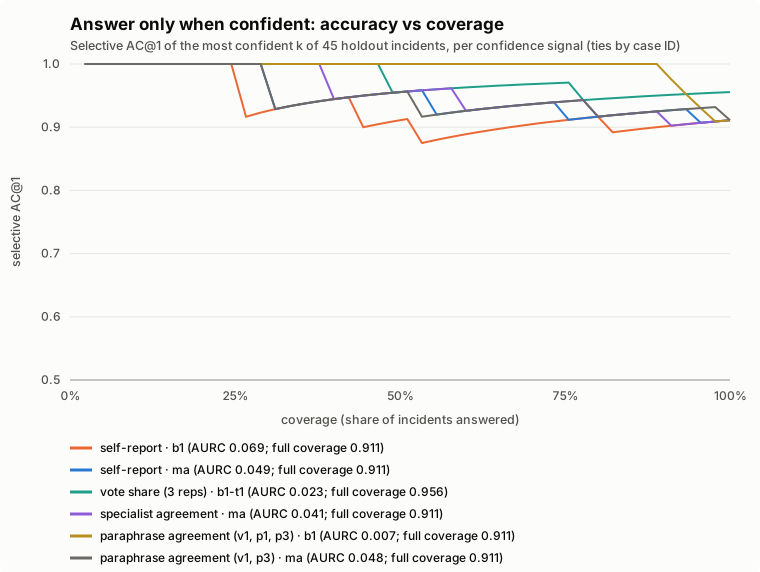
For an incident tool, knowing when to escalate to a human matters as much as accuracy. I scored each pre-registered confidence signal by selective accuracy: answer only the incidents you are most confident about.
| Signal | Accuracy on the most confident 70 % | Errors caught in the least confident 20 % |
|---|---|---|
| Single agent says “confident” | 90.6 % | 1 of 4 |
| Multi-agent says “confident” | 93.8 % | 1 of 4 |
| Agreement among the multi-agent system’s specialists | 93.8 % | 1 of 4 |
| Agreement among 3 single-agent samples at temperature 1.0 | 96.9 % | 0 of 2 |
| Agreement across 3 differently worded single-agent runs | 100 % | 4 of 4 |
The model’s own “confident” is useless; the single agent said it every time. Temperature samples rarely disagree, so their agreement says little. But when three differently worded runs of the single agent named the same service (40 of 45 incidents), it was right every time, and the five where they disagreed contained all four of its errors. Answering the 89 % where they agree and escalating the rest gives 100 % accuracy on what is answered, on these 45 cases, for about the multi-agent system’s price. (Four errors and 45 cases: a point estimate, not a guarantee.)
What the cases show
Tracking every wrong answer across all eight configurations of both systems separates two kinds of error:
- Fragile errors, fixed by almost any perturbation: the single agent’s database-for-service mix-up and its late distraction (fixed by sampling, by either rewording and by renaming), and the multi-agent system’s follow-up override (fixed by rewording and by renaming).
- Robust errors, surviving every perturbation: one incident neither system ever queried the true service for, one where both followed the digest’s misleading top anomaly, and one where the multi-agent system kept blaming a caller.
So the single agent’s “reading errors” from Result 1 were not a systematic weakness of reasoning in one context. They were fragile, and re-running the agent differently fixed them as well as coordination did. The errors that survive are shared by both designs, or belong to the multi-agent system.
What this means for teams building agent systems
- Perturb and vote a single agent before building a multi-agent system. On this task, three differently worded or sampled runs of one agent matched or beat the multi-agent system’s accuracy at the same or lower spend.
- Know what coordination actually buys. Here it was not better reasoning. It was stability across prompt versions (useful where answers must be reproducible: audits, regulated settings) and robustness to timeouts on a slow model. Both are real, and the second can be built into one agent for less.
- Get the abstention signal from disagreement, not from the model’s words. Self-reported confidence was useless; agreement across independent prompt variants caught every error.
- Coordination has its own failure modes; write its rules as code. A follow-up that re-asks the dissenting specialist is not independent evidence. On dev it turned six right answers wrong until a rule required two independent specialists to overturn a ranking.
- Measure robustness per case, not only accuracy per arm. Aggregate accuracy moved by at most a case or two under any perturbation; the per-case view showed which errors are worth engineering against (evidence gaps, misleading summaries) and which disappear on their own.
- Check for contamination and check your determinism assumptions. Renaming every service ruled out memorization; a temperature fixed at 0 deep in the model layer had quietly made “no run-to-run variance” a configuration fact rather than a finding.
- Invest in the deterministic layer. A five-line rule over the anomaly digest, with no model, reached 0.76.
How the study was run
The comparison is only worth anything if it is fair and reproducible, so most of the engineering went there:
- No peeking. A grouped dev/holdout split committed before any run; holdout labels reachable through one package only, enforced by an import-linter rule; for each of the three experiments, a pre-registered analysis plan and a freeze file hashing the model, budget, prompts and every file on the decision path; a holdout runner that refuses to start if any hash differs.
- Equal information. Every fault in the dataset starts exactly 720 s into the recording, so timestamps leak the onset; both systems are given the alert time explicitly, through one shared header.
- Money safety. A fail-closed model registry, a worst-case cost reservation before every call, a ledger, a per-incident cap and spend stops enforced in code. Each paid phase ran under a hard cap set by the owner.
- Reliability. An
asyncio.TaskGroupfan-out where no worker failure can cancel its siblings; retries with backoff; six injected-fault scenarios (rate limit, timeout, malformed output, crash, invalid evidence, killed runner) tested in CI with a scripted model at $0. - Observability. Every run’s journal converts to OpenTelemetry traces (agent, LLM and tool spans with token counts and cost) viewed in a local Arize Phoenix. A static HTML replay per run shows the parallel agents, the hypothesis board and every claim linked to its evidence.
- Reproducibility. Real runs record to cassettes and replay byte-for-byte; every analysis regenerates in one command; a clean-clone check rebuilds and tests the repository from scratch.
Things that went wrong, and were caught before they could bias a result:
- Budget estimates, not dollars, were binding. A guard sized calls on pessimistic token estimates, which starved the multi-agent system.
- One dissenter could overturn a majority. A coordinator rule allowed it, until the two-specialist rule replaced it.
- The stronger model rejected our message format. It refused text placed after a tool result, which broke the coordinator on every call.
- Time limits were sized for the fast model. The slow model’s latency spikes turned into failures.
- A pseudonymizer missed name variants. Its first version missed glued and CamelCase forms; a leak test now fails if any form of any name reaches a model.
Each is documented with its fix.
What I built, and how
I designed the study and the system, set the evaluation protocol, and made every decision about models, budgets, fairness and what counted as a result. Implementation was done by AI coding agents (Claude Code and Codex) working from written work-package briefs, each in its own git worktree, merging only through pull requests with green CI, under rules I set: no agent could touch the data contracts, read holdout labels or spend money. Later, I delegated the paid runs and holdout steps to the orchestrating agent within hard spend limits enforced in code, with every delegated decision labelled as such.
| Duration | 9 days (11–19 Oct 2026) |
| Experiments | 3 frozen, pre-registered experiments on the same 45 held-out incidents (v1, a two-model replication, four follow-ups); about 600 held-out runs plus dev, tuning and variance studies |
| Process | ~170 merged pull requests; decisions recorded as ADRs and dated decision entries |
| Model spend | $32.72 total |
What this demonstrates, for anyone hiring for senior or staff AI engineering:
- Designing and running a fair, pre-registered evaluation of agent architectures, reporting a null result, a surprising positive result and the follow-ups that explained both with the same rigour, and correcting my own earlier claims when the evidence changed.
- Building production-shaped agent systems: concurrency, budgets, failure handling, evidence validation, deterministic replay, observability with OpenTelemetry and Phoenix.
- Cost-aware engineering: every call priced, capped and accounted for; three experiments for $33.
- Directing AI coding agents at scale with guardrails, review checkpoints and an auditable decision trail.
Read more
The full results, the three pre-registrations, the architecture document, the failure taxonomy and the week-by-week case studies are kept in the project repository alongside the code.