Open source · vllm-project/semantic-router · #6258
Keeping a model runtime alive after a log line over 1 MiB in vLLM Semantic Router
vLLM Semantic Router starts its model runtime as a child process and forwards every line it prints into the router's logs. One line over 1 MiB made the reader quietly give up. Nothing drained the pipe after that, so the next write blocked, the process looked hung, and the supervisor never noticed. The fix had to keep reading without losing output and without making normal shutdowns noisy.
Context: a supervisor that forwards runtime logs
vLLM Semantic Router is an Envoy ExtProc router that picks a model backend for each LLM request. The models it uses for that decision (classifiers, embeddings) are served by a separate model runtime process. A supervisor in pkg/modelservice/supervisor.go starts that process, restarts it when it exits, and forwards each line it prints as a runtime_log event so operators see one log stream. Stdout and stderr share one pipe.
Issue #6258 reported that this forwarding could stop for good.
Symptom: the runtime hangs and is never restarted
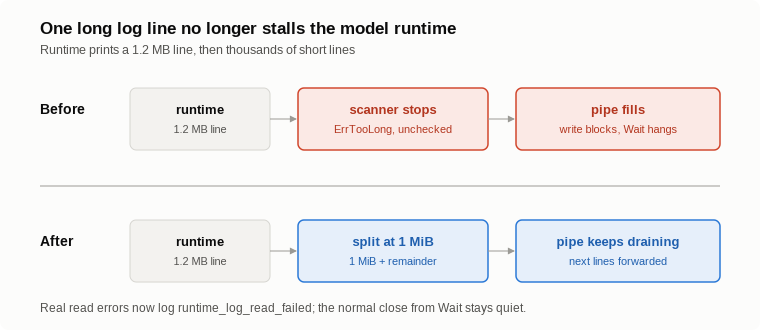
If the runtime prints one line longer than 1 MiB, log forwarding stops with no error. Shortly after, the runtime freezes and the supervisor keeps waiting on it.
I reproduced it on main with a child that prints a 1.2 MB line, then 20000 short lines, then creates a marker file:
head -c 1200000 /dev/zero | tr '\0' a; echo; (20000 x echo after); touch done; sleep 30- 1.2 MB line: the marker never appears within 5 seconds, 0
runtime_logentries after the long line. - 500 KB line as a control: passes in 0.21 s with 20001 entries.
Root cause: the scanner gives up and nobody reads the pipe
forwardLogs used a bufio.Scanner with a 1 MiB max token. A longer line makes Scan() return false with bufio.ErrTooLong. The loop ended, the goroutine returned, and the error was never checked. Nothing read the pipe after that. Once the OS pipe buffer filled, the child blocked on its next write, so cmd.Wait never returned and the restart logic never ran.
Constraints
- Keep reading no matter what. Any fix that can stop reading the pipe early brings the hang back.
- Do not lose output. The lines after a giant one are often the useful ones, such as the error that follows a dump.
- Keep memory bounded. The 1 MiB cap exists so a runaway line cannot grow the buffer without limit.
- Normal exits must stay quiet.
cmd.Waitcloses the pipe when the process exits, so a read in progress can fail withos.ErrClosedon an ordinary shutdown. Surfacing read errors, as the issue asked, must not turn that into a warning on every restart.
Design
Chosen: split oversized lines inside the scanner. A custom split function wraps bufio.ScanLines. When it would ask for more data and the buffer already holds 1 MiB, it returns the whole buffer as a token. ErrTooLong can no longer fire, nothing is dropped, the max record size and memory stay the same, and the read loop is untouched. After the loop, a real read error is logged as runtime_log_read_failed, except os.ErrClosed.
Rejected: truncate with bufio.Reader.ReadSlice. Bounded too, but it drops the rest of the line, allocates 1 MiB per start, needs a new truncated field and is a bigger diff.
Rejected: io.Copy(io.Discard) after the scanner stops. Stops the hang but throws away every later log line.
Out of scope: runOnce calls Wait while logs are still being read, so a crashing runtime can lose its last lines. Separate bug, noted in the PR.
The fix
const maxLogLine = 1024 * 1024

scanner.Buffer(make([]byte, 64*1024), maxLogLine)
scanner.Split(func(data []byte, atEOF bool) (int, []byte, error) {
	advance, line, err := bufio.ScanLines(data, atEOF)
	if line == nil && len(data) >= maxLogLine {
		return len(data), data, nil
	}
	return advance, line, err
})
// ... forwarding loop unchanged ...
if err := scanner.Err(); err != nil && !errors.Is(err, os.ErrClosed) {
	logging.ComponentWarnEvent("model_runtime", "runtime_log_read_failed", ...)
}
A 1 MiB + 10 byte line now arrives as two runtime_log records (1 MiB, then 10 bytes) followed by the next line as normal.
Verification
All three tests were written first and failed on main.
| Test | What it checks | On main | With fix |
|---|---|---|---|
TestSupervisorKeepsReadingAfterAnOversizedLine |
Real sh child: 1.2 MB line, 40000 lines, then a marker file |
Blocked for 5 s | Marker appears |
TestSupervisorForwardsAnOversizedLineInPieces |
forwardLogs on an in-memory reader gives exactly 1 MiB, 10 bytes, after |
0 lines | Pass |
TestSupervisorLogsAFailedLogRead |
Closed pipe logs nothing; a failing reader logs one warning with process and error | No warning | Pass |
A design review caught a flaky first draft: the process test also asserted on log content, but the forwarding goroutine outlives runOnce and logged into the next test iteration (18 of 20 runs failed under -race in isolation). I moved content checks into the synchronous test and kept the process test to “did the child get unblocked”.
Ran locally on macOS arm64:
go test ./pkg/modelservice/ -run TestSupervisor -count=1 -v: 5/5 pass- New tests with
-race -count=10: pass go test ./pkg/modelservice/... -count=1: okgo veton darwin andGOOS=windows,gofmt,golangci-lintwith the repo config: cleanmake config-schema-check: pass
make test-semantic-router and the model runtime E2E profile need the full router build and are left to CI.
Core concepts this exercised
- Pipes and backpressure between processes. A child writing to a pipe blocks once the buffer is full. A reader that stops is not a logging problem, it is a liveness problem for the whole process.
- Silent goroutine exits.
Scan()returning false looks the same for EOF and for failure. Not checkingscanner.Err()turned a recoverable condition into a hang with no log line. - Choosing data preservation over truncation. Splitting keeps every byte with the same memory bound, so there was no reason to accept losing the newest output.
- Separating noisy expected errors from real ones. The new warning is only useful if it does not fire on every normal exit, so
os.ErrClosedfromWaitis excluded and tested. - Deterministic tests for process-level bugs. Asserting on observable effects (a marker file) in the process test, and on content only in a synchronous test, removed the goroutine-lifetime flake.