Open source · llm-d/llm-d-router · #3931
Keeping a request on one rollout revision across a conditional-decode miss in llm-d-router
During a rollout, the llm-d router pins every phase of a disaggregated request to one revision by forwarding a header from phase to phase. On a prefix cache miss, the first probe came back as a 412 and the coordinator threw its headers away, so the rest of the request could land on a different revision. The fix in the coordinator is one line. Deciding how to split the problem, and what the EPP side needs, was the real work.
Context: one request, several hops, one revision
The llm-d router serves LLM traffic with prefill and decode split across different vLLM pods. A coordinator runs each request as a pipeline of steps, and each step goes through the gateway to an Endpoint Picker (EPP) that chooses a pod for that phase. In larger deployments the encode, prefill and decode phases can each have their own EPP.
When a new set of prefill and decode pods is rolled out, a screener plugin in the EPP picks a revision for the request and stamps it on the response as x-llm-d-disagg-revision. The coordinator copies that header onto the next phase’s request, and the next EPP treats it as a strict filter. That forwarded header is how separate EPPs agree on a revision without sharing state.
The first step is often a conditional-decode probe: the coordinator asks the decode EPP to serve the request directly (Prefer: if-available) if the prompt prefix is already cached. On a miss the EPP answers 412 Precondition Failed, and the coordinator continues with encode, prefill and decode. Issue #3931 reported that the revision chosen for the probe did not survive that 412.
Symptom: the probe’s revision vanishes
In a three-EPP cascade, the decode EPP scheduled the probe against revision B and answered 412. The prefill request that followed carried no revision header, so the prefill EPP made a fresh, unpinned choice, and decode followed whatever prefill picked. One logical request could start on one revision and finish on another, which is exactly what the screener exists to prevent.
I reproduced the coordinator side with a flow test: a pipeline of conditional-decode, prefill and decode against a fake gateway that answers the probe with a 412 carrying X-LLM-D-Disagg-Revision: revision-b.
go test ./pkg/coordinator/steps/ -run 'TestResponseHeaders_' -count=1
--- FAIL: TestResponseHeaders_FlowFromConditionalDecodeMiss
    prefill revision header = "", want "revision-b"
    decode revision header = "", want "revision-b"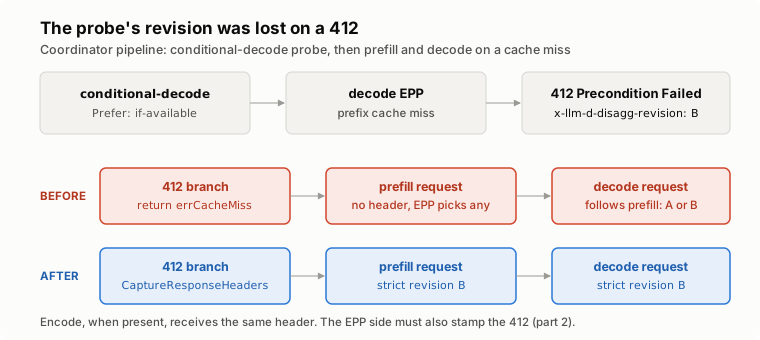
Root cause: two halves, both missing
The coordinator ignored headers on the 412. In pkg/coordinator/steps/conditional_decode.go, the 412 branch marked a cache miss and returned errCacheMiss. The encode, prefill and render steps all call reqCtx.CaptureResponseHeaders(resp.Header) on their responses. This branch didn’t, and the docs said as much: 412 hints “are not yet consumed by the coordinator”.
The EPP never stamps the revision on the 412. The 412 is an error returned by the PrefixBasedPDDecider during PreRequest, which the server turns into an immediate response. The screener only stamps the revision in its ResponseHeader hook, and that hook runs when an upstream pod answers. On an immediate response no pod answered, so the hook never runs and the error carries no headers.
Fixing either half alone does nothing for the reported case. Both are needed.
Constraints: the halves are not equally safe
The coordinator half is small and self-contained. The EPP half is not. Getting one plugin’s header onto an immediate response produced by a different plugin has no existing mechanism. Running every response-header plugin on the 412 would break the documented contract that those hooks run for “the pod that served the request”: session affinity would hand out a token for a pod that never served, and latency and LoRA-residency plugins would record side effects for work that didn’t happen. That code also overlaps an open PR that rewrites the same director error path.
Design: split the fix along ownership lines
I wrote up both halves on the issue and split them into two PRs.
For the EPP half, three options went through a design review:
- Run all response-header plugins on post-scheduling rejection. About 25 lines, but it changes the hook contract and triggers the side effects above. Rejected.
- Have the decider stamp the revision from its own config. Wrong layer: it duplicates the screener’s header and label settings and misses the 412 the router returns by default when no gate plugin is configured. Rejected.
- An opt-in
RequestRejectedhook, modeled on the recently mergedRequestAbandonedinterface, that the director calls only for plugins that implement it, with the screener delegating to its existing stamping logic. This is the one I proposed. It touches framework code owned by the router maintainers, so it waits on their sign-off.
The coordinator half didn’t need to wait. Once a 412 carries the header, the coordinator has to forward it, whichever EPP mechanism wins. That became PR #4044, marked “Part of #3931” so the issue stays open for the second half.
For the coordinator change itself I checked a few things before writing it. StripInternalHeaders does not strip the revision header. The default forward_response_headers already includes it. The callback runs synchronously, so there is no concurrency concern. I placed the call inside the 412 case rather than restructuring the switch, to stay clear of another open PR editing the same file.
The change also has a behavior consequence worth stating in the PR. After a 412 that carries a revision, encode and prefill become strict on that revision. If the revision has no ready pod for a role, the request fails with a 503 instead of silently switching revisions. That matches how prefill to decode already behaves, and failing closed is the right default during a rollout.
The fix: one line and two doc notes
case resp.StatusCode == http.StatusPreconditionFailed:
	cacheMiss = true
	reqCtx.CaptureResponseHeaders(resp.Header)
	coordmetrics.IncConditionalDecodeProbes(coordmetrics.ProbeResultDeferred)
	return errCacheMiss
CaptureResponseHeaders keeps only the names listed in forward_response_headers, so nothing new leaks to later phases. I updated docs/coordinator_architecture.md and docs/communication.md to say the coordinator now forwards those 412 headers and still ignores hints in the 412 body.
Verification
The flow test above was written first and failed for the expected reason. I then made it table-driven:
| Case | Prefill and decode receive |
|---|---|
412 carries revision-b |
revision-b |
| 412 without a revision header | no header, later phases unconstrained |
Both cases pass with the fix. Locally I ran go test ./pkg/coordinator/..., gofmt and go vet on the coordinator packages, and the project’s golangci-lint and typos checks scoped to pkg/coordinator/steps inside the builder container. The full make lint was OOM-killed in a 4 GB colima VM on my 8 GB Mac, so the complete presubmit was left to upstream CI. I didn’t add a separate encode-path flow test, since the multimodal fixtures are heavy and encode reads the same captured headers. Whether Envoy passes immediate-response headers through end to end, and the reporter’s GPU measurement, are outside what I could run.
Core concepts this exercised
- A header is a contract between components. The revision header only works if every hop stamps it and every hop forwards it. The bug was one hop that did neither on its error path.
- Split along ownership lines. The coordinator half was safe and needed no one’s sign-off. The EPP half needed a framework hook. Shipping the first while proposing the second kept progress moving without forcing a framework change through.
- Fail closed during a rollout. Forwarding the revision turns a silent revision switch into a visible 503 when a revision is missing a role. That is a behavior change, so it went in the PR text, not just the code.
- Respect hook contracts. Reusing every response-header plugin on a rejection would have been fewer lines and wrong. An opt-in interface changes nothing for plugins that don’t ask for it.
- Test both sides of the condition. The table covers the 412 with and without the header, so the fix is shown to forward what is there and invent nothing when it is not.