Open source · BerriAI/litellm · #50024
Keeping Azure reasoning intact on LiteLLM's /v1/messages route
Azure Responses deployments reached through /v1/messages lost the model's encrypted reasoning on every follow-up turn, because the request detoured through chat completions on the way. The obvious fix, adding Azure to the direct-route list, would also have moved every plain Azure chat deployment, so the work was finding the narrower condition.
Context: two ways a Messages request can reach a Responses model
LiteLLM exposes an Anthropic-format /v1/messages endpoint in front of many providers. For a model served over OpenAI’s Responses API there are two routes inside litellm/llms/anthropic/messages/native/handler.py. The direct route sends the request to a Responses adapter. The other converts Messages to Chat Completions and calls litellm.completion, which may itself bridge back to Responses for models that need it.
_should_route_to_responses_api picks between them. A provider in _RESPONSES_API_PROVIDERS, which is just {"openai"}, always goes direct. Other providers go direct only when stripping the provider prefix would lose the Responses mode.
Reasoning models return an encrypted reasoning blob that the client must send back on the next turn after a tool call. LiteLLM carries it inside the thinking block’s signature. Issue #50024 reported that for Azure it was being dropped.
Symptom: turn two arrives at Azure with no reasoning
With an Azure deployment like azure/responses/<deployment>, or any Azure deployment pinned to model_info.mode: responses, a two-turn tool call sends the second turn to /openai/v1/responses with zero reasoning items and no include: ["reasoning.encrypted_content"]. The model has to rebuild its reasoning from nothing.
I ran the issue’s script, with its import path updated to the module’s new location, on main:
azure/responses/gpt-5.6-terra default
   .../openai/v1/responses?api-version=v1 reasoning items: 0 include: None
azure/responses/gpt-5.6-terra with azure in set
   .../openai/v1/responses?api-version=v1 reasoning items: 1 include: ['reasoning.encrypted_content']
azure/gpt-5.6-terra default
   .../openai/v1/chat/completions reasoning items: 0 include: None
azure/gpt-5.6-terra with azure in set
   .../openai/v1/responses?api-version=v1 reasoning items: 1 include: ['reasoning.encrypted_content']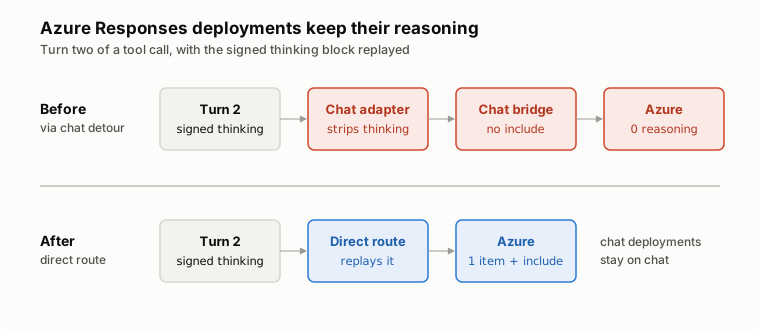
Both URLs for the first row end at /responses, which matters later: the URL is the same before and after the fix, so a test that only checks the path cannot see the bug.
Root cause: the detour strips the signature and never asks for it back
For azure/responses/gpt-5.6-terra the resolved model is responses/gpt-5.6-terra, which still resolves to Responses mode, so the prefix-strip check returns false and the request takes the chat detour. On the way, the Messages-to-Chat adapter drops bridge-tagged thinking blocks on purpose, and the chat-to-Responses bridge it ends in never sets include: reasoning.encrypted_content. The direct adapter does both correctly for any provider whose Responses config supports include, and Azure’s does.
Constraints: the suggested fix moves too much
The issue suggests adding "azure" to _RESPONSES_API_PROVIDERS. The last row of the output above shows why that is not safe: a plain azure/gpt-5.6-terra chat deployment also moves from /chat/completions to /responses. Many Azure deployments are chat-only, older API versions among them.
The history agrees. Azure was in that set when it was introduced and was removed again in commit 99c62ca40e, with no reason stated in the commit, and the test for azure/o1 was updated in the follow-up to expect litellm.completion. Whatever the reason, the existing tests pin the current behavior, and putting Azure back would fail three of them.
Design: go direct only when the deployment already resolves to Responses
I compared four options before writing code, in a design review that approved the plan with changes to the tests:
- Add
"azure"to the provider set. Rejected: moves every Azure chat deployment and reverts a deliberate change. - Early return for Azure that reuses the existing bridge check. Chosen.
_bridges_to_responses_apiis the sameresponses_api_bridge_checkthatlitellm.completionruns, so only requests that were already going to end up at/responsesmove, and they skip the lossy detour. - The same for every provider. Deferred. It would change routing for around eight providers (ChatGPT, GitHub Copilot, Bedrock Mantle, xAI and others), which is a product decision, not a bug fix.
- Stop stripping thinking blocks in the Messages-to-Chat adapter. Rejected: the adapter cannot know whether
completionwill bridge, and stripping protects Gemini and Bedrock.
I put the check inside _should_route_to_responses_api rather than in the Azure call site, so the dispatcher’s route lookup and the proxy’s token counting make the same choice as inference does. I used an early return for Azure instead of an extra clause, because for Azure the prefix-strip check can never disagree with the bridge check (the reviewer checked all 319 Azure rows in the cost map), and the early return avoids a second model-info lookup. The opt-out flag, stop_sequences and compaction exclusions above it still apply first.
The fix: two lines
    if custom_llm_provider is None or requested_model is None or resolved_model is None:
        return False
    if custom_llm_provider == LlmProviders.AZURE.value:
        return _bridges_to_responses_api(resolved_model, custom_llm_provider, deployment_model_info)
    return _responses_mode_is_lost_by_prefix_strip(
        requested_model, resolved_model, custom_llm_provider, deployment_model_info
    )
A deployment with the responses/ prefix, a model_info.mode: responses pin, or a cost-map row with mode: responses now goes direct. A mode: chat pin and a plain deployment stay on chat.
Verification: assert on the body, because the URL does not change
The review pointed out that at base the request already reaches /responses, so the test has to assert on the body. I wrote test_azure_responses_deployments_replay_encrypted_reasoning first, cutting the connection at the wire with respx so nothing leaves the process. Each case runs streaming and non-streaming, and checks the URL path, the exact encrypted_content of the replayed reasoning item, and the include list.
| Deployment | Expected route | Reasoning replayed |
|---|---|---|
azure/responses/qa-deployment |
/responses |
Yes |
azure/qa-deployment pinned mode: responses |
/responses |
Yes |
azure/qa-responses-row, a synthetic cost-map row |
/responses |
Yes |
The same row pinned mode: chat |
/chat/completions |
No |
Plain azure/qa-deployment |
/chat/completions |
No |
At base the six responses-mode cases fail on the body assertion ({()} == {('qa-opaque-reasoning',)}) and the four chat cases pass, so the chat cases guard against the rejected option. With the fix the new test gives 10 passed and the whole file 112 passed. A broader run over the Anthropic, Rust bridge, token counter and Responses test directories passed about 7,500 tests, and the failures that remained are a subset of the failures on main, which are the existing ones. Three mutations were caught: checking requested_model instead of resolved_model fails the prefix case, dropping the deployment model_info fails the pin cases, and sending every Azure deployment direct fails both chat cases.
What this does not show: I have no Azure credentials, so I did not run a two-turn tool call against a real Azure Responses deployment. The tests prove what LiteLLM sends, not that Azure accepts it, and the PR says so and asks for a maintainer with a deployment to confirm. The CI run on the PR is still pending.
Risks left on the table
- A gap this does not close. A plain Azure deployment of a newer model with function tools and reasoning is still routed to chat and bridged dynamically inside
completion, with zero reasoning items. Pinningmodel_info.mode: responseson that deployment works around it. - A new exposure. Azure-issued encrypted reasoning is now replayed, so a group spread over several Azure resources should turn on
encrypted_content_affinity, the same exposure multi-organization OpenAI groups already have. - Request shape. Moved requests now get the direct path’s body, for example tool
strictbecomingfalseand tool output sent as a string.
Core concepts this exercised
- Scope the fix to the failing path. The suggested one-line change fixed the repro and also moved traffic that was never broken. Reusing the check
completionalready runs kept the change to requests that were already headed for Responses. - Read history before reverting it. Azure had been in the set and was taken out on purpose. Finding that, and the tests that pin it, ruled out the simplest fix.
- Assert on what goes over the wire. When the URL is identical before and after, only the request body shows the difference. The tests assert on the exact encrypted payload and the
includelist. - Put the decision where every caller sees it. Fixing
_should_route_to_responses_apikeeps dispatch and token counting consistent with inference. - Say what was not verified. Without Azure credentials the proof is wire-level, and the PR text names that gap and what a maintainer would need to run.