Open source · BerriAI/litellm · #49931
Stop caching empty replies in LiteLLM's response cache
One empty reply from Gemini through /v1/messages got cached, and every identical request after it replayed the empty answer without reaching the provider again. The cache decided a stream had output if any content block was opened, so the fix had to read what was inside the block without starting to reject real replies that look empty. The same gap turned out to exist for non-streamed replies, the chat route, and Gemini replies that carry only a hidden thought signature.
Context: a gateway that speaks Anthropic to every provider
LiteLLM is a gateway that exposes one API in front of many model providers. Its /v1/messages endpoint speaks Anthropic’s Messages format, and for a provider like Gemini an adapter translates the Gemini stream into Messages server-sent events: message_start, content_block_start, content_block_delta, content_block_stop, message_delta, message_stop.
The proxy can sit a response cache (Redis, in my runs) in front of that. A streamed reply is stored as the list of SSE frames it was sent as, under CACHED_STREAM_EVENTS_KEY, and replayed on an identical request. Before storing and before serving, is_response_without_output in litellm/caching/caching_handler.py decides whether the payload is worth keeping, so a reply with nothing in it is not remembered.
Issue #49931 reported that for a Gemini model that check was letting an empty reply through.
Symptom: one empty answer, then the provider is never asked again
When Gemini returns a single empty text part, the adapter still emits a text block with "text": "", opens it and closes it. The client sees an empty answer, which is bad enough. With the cache on it gets worse: the second identical request comes back with the same empty stream and an x-litellm-cache-key header, and the provider is not called at all.
I reproduced it with the issue’s script against a small mock Gemini server that counts requests:
$ uv run python .oss/49931/repro.py empty
call 1 events: ['message_start', 'content_block_start', 'content_block_stop', 'message_delta', 'message_stop']
call 2 events: ['message_start', 'content_block_start', 'content_block_stop', 'message_delta', 'message_stop']
requests to the server: 1        <- should be 2

$ uv run python .oss/49931/repro.py text      (control, reply "hello")
requests to the server: 1        <- correct, real answers are cached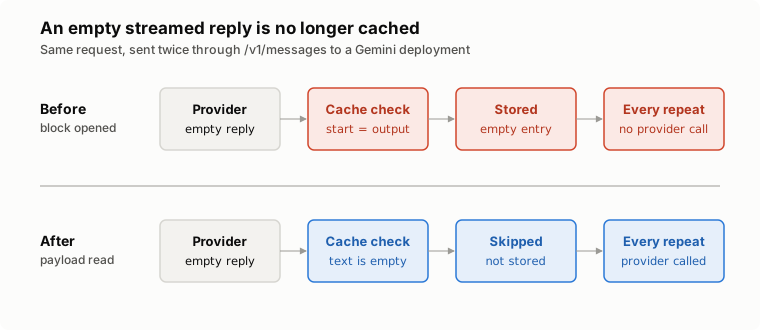
The streamed Messages path was the one reported, but it was not the only one. A non-streamed Messages reply with an empty text block, and a chat completion whose only choice has an empty message, both passed the same “has output” check, because that check only asked whether a block or choice existed. Gemini adds one more shape: a reply that stops early can hold nothing but its hidden thought signature, which the client never sees.
Root cause: a block was opened, so it counted as output
In caching_handler.py, _starts_content_block returned true for any frame containing the line event: content_block_start, and is_response_without_output said a Messages stream has output if any frame did. The adapter’s empty text block is a content_block_start followed by a content_block_stop, so it passed.
That check runs on both sides. AnthropicMessagesStreamCacheWriter._persist in llms/anthropic/messages/native/response_cache.py calls it before storing, and the sync and async read paths treat a stored no-output payload as a miss. The chat-stream rule next to it was stricter: a choice carries output only if a field other than role holds a non-empty value. The Messages check was simply coarser than the bar chat already used.
Constraints: tightening the check without breaking real streams
The tempting fix is “skip a stream if its text is empty”. Several real streams look empty to that rule:
- Tool calls. A
tool_useblock starts with"input": {}and aninput_json_deltawith"partial_json": "". There is no text anywhere, and it is a real answer that must stay cached. - Line endings. A stream cached as one chunk with CRLF line endings has to keep working, which rules out anything that assumes one frame per event.
- Unicode.
str.splitlinesalso splits on U+2028, so text containing that character gets cut in the middle of a JSON line. - Non-JSON data lines. A
data: [DONE]line is valid SSE and has to be skipped, not crash the check.
Two scoping limits as well. Another contributor’s open PR (#48343) stops the adapter from synthesizing the empty block in the first place. That is a different fix and it would not clear entries already stored, so I left the adapter alone. And a fix on the write side only would leave stored empty entries replaying until their TTL, so it had to cover reads too.
Design: one predicate in the cache module
Three approaches went through a design review before code:
- A payload-aware predicate in
caching_handler.py. Replace_starts_content_blockwith a check that parses eachdata:line, looks at thecontent_blockof acontent_block_startor thedeltaof acontent_block_delta, and counts it as output only if some key other thantypehas a value that is not"",[]orNone. It is one file, and fixingis_response_without_outputfixes the write side and both read paths together. - The same predicate inside the Anthropic module. It needs two files and an import round trip, and the helpers there decode strictly and misread CRLF.
- Assemble the stream and reuse the chat rule. It prints the provider-list banner, rebuilds the whole response on every cache hit, and misjudges CRLF.
I took the first, with three changes the review asked for. The JSON TypeAdapter is built once at module level rather than per call, because building it per call was about 50 times slower. The branch is on the parsed JSON type with a match, not on the text of the event: line. And the CRLF single-chunk stream is pinned by a test, so a later change can’t quietly stop caching it.
The fix: read the payload, not the block marker
_SSE_EVENT_DATA: Final = TypeAdapter(Mapping[str, object])

def _content_block_payload(event: Mapping[str, object]) -> object:
    match event.get("type"):
        case "content_block_start":
            return event.get("content_block")
        case "content_block_delta":
            return event.get("delta")
        case _:
            return None

def _sse_line_carries_output(line: str) -> bool:
    event: Final = _sse_event_data(line)
    payload: Final = as_str_mapping(_content_block_payload(event)) if event is not None else None
    return payload is not None and any(
        key != "type" and value not in ("", [], None) for key, value in payload.items()
    )
Lines come from the existing split_sse_lines helper rather than str.splitlines, and a line that is not valid JSON returns no event instead of raising. is_response_without_output now asks whether any frame has a line that carries output. I changed the writer’s debug message from “no content blocks” to “no output”, since that is now what it checks.
Widening it: one bar for every reply shape
The same rule now applies to every shape the cache stores:
- Non-streamed Messages. A stored
type: messagepayload has output only if one of its content blocks does, using the same block check as the stream. - Chat completions, streamed or not. A choice has output only if a message field other than
roleholds something. An assembled stream goes through the same check, so the empty choice the stream wrapper adds at the end no longer counts. - Replay metadata is not output. Inside
provider_specific_fields,thought_signaturesandcontinuation_tokenare ignored, so a reply holding only Gemini’s thought signature counts as empty. - Fills stay cached. A text completion choice counts as output whenever its text is not
"", so code-completion fills that are only indentation or a newline, and whitespace replies in general, are still cached.
_REPLAY_METADATA_FIELDS: Final = frozenset({"thought_signatures", "continuation_token"})

def _message_field_carries_output(key: str, value: object) -> bool:
    match key:
        case "role":
            return False
        case "provider_specific_fields":
            fields: Final = as_str_mapping(value) or {}
            return any(
                name not in _REPLAY_METADATA_FIELDS and field not in ("", [], {}, None)
                for name, field in fields.items()
            )
        case _:
            return value not in ("", [], {}, None)
The final change is 339 additions and 33 deletions across caching_handler.py, the Messages cache writer, and their two test files.
Verification: break it on purpose, then run it for real
I wrote the failing cases first. The new cases join the existing empty-response tests in test_caching_handler.py, which feed both the “do not store” and “treat a stored one as a miss” tests: an empty text block, a block with citations: None and a blank text_delta, and a block with citations: []. The writer test in test_response_cache.py became a parametrized test_stream_without_output_is_not_cached, renamed because what it claims changed. A parametrized replay test covers the cases that must still be cached:
| Stream | Must be |
|---|---|
| Plain text | Cached |
tool_use with input: {} and empty partial_json |
Cached |
| Whole stream as one CRLF chunk | Cached |
| Text containing U+2028 | Cached |
A data: [DONE] line in the stream |
Cached |
| Only an empty text block | Not cached |
| No content blocks at all | Not cached |
With the old caching_handler.py and the new tests, 7 fail and 117 pass. With the fix, the two test files give 125 passed. A script that mutates the new check then confirmed the tests can tell. All 8 mutants were killed: treating None as output, treating [] as output, counting the type key, splitting with str.splitlines, ignoring delta payloads, ignoring start payloads, only reading the first line of a frame, and dropping the ValidationError catch. An independent code review in two rounds found a stray whitespace change and two surviving mutants in the first, and nothing blocking in the second.
The unit tests feed hand-written SSE through the native handler, so they do not exercise the Gemini adapter. For that I ran a live proxy with two workers and a Redis response cache, pointed a gemini/gemini-2.5-flash model at a local server that always returns one empty text part and counts requests, and sent the same streamed /v1/messages call three times:
| Run | Provider hits across the 3 calls | Cache header on calls 2 and 3 |
|---|---|---|
| Before (main) | 1, 1, 1 | Present, stored entry in Redis |
| After, stale entry still in Redis | 1, 2, 3 | Absent |
| After, upstream replies “hello” | 1, then 1 | Present, real answers still cached |
The after-run log shows three “treating it as a miss” lines for the stored empty entry and three “not caching a stream with no output” lines.
For the wider fix, the end-to-end check moved to real Gemini. Two proxies with two workers each shared one Redis, each case alternated its calls between them, and a forwarder in front of Google counted the requests that actually reached Gemini. At max_tokens: 16, Gemini 3.8 Flash often returns only a thought signature, so each empty case retried new prompts until it did. Codestral covered the code-completion fills.
| Case | Before | After |
|---|---|---|
| Messages stream, empty | Replayed | Gemini called |
| Messages, not streamed, empty | Replayed | Gemini called |
| Chat stream, empty | Replayed | Gemini called |
| Chat, not streamed, empty | Replayed | Gemini called |
| SDK stream, empty | Replayed | Gemini called |
| Empty entry stored by the old version | Replayed | Gemini called |
| Text and tool replies | Cached | Cached |
| Code fills: indentation, newline or empty | Cached | Cached |
At the final commit, 140 focused tests and make check pass, and the PR is merged.
Core concepts this exercised
- Admission policy needs the same bar on both sides. The write path decided what to store and the read path decided what to serve. Fixing the shared predicate fixed both, including entries already stored.
- Match on payload, not on markers. An opened block says nothing about whether it holds anything. The fix reads the content, using the same “any field other than the type tag” rule chat streams already use.
- Guard against over-tightening. Tool calls, CRLF streams, U+2028 and
[DONE]lines are all shapes where a tighter check could start dropping real answers. Each has a test that passes before and after. - Mutation testing as a test audit. A mutation script showed two survivors and one equivalent mutant after my first version, which is how I found a branch no realistic stream could reach.
- Reproduce at the layer where it lives. Unit tests skip the adapter that creates the empty block. The proxy runs against real Gemini are what show the whole path, across both routes and both response modes.
- Fix the class, not the instance. The report was one route in one mode. The same coarse check sat behind every reply shape the cache stores, so the fix applies one definition of “has output” everywhere, including what does not count as output.