Open source · ai-dynamo/dynamo · #17641
Pinning Dynamo sessions to one data-parallel rank
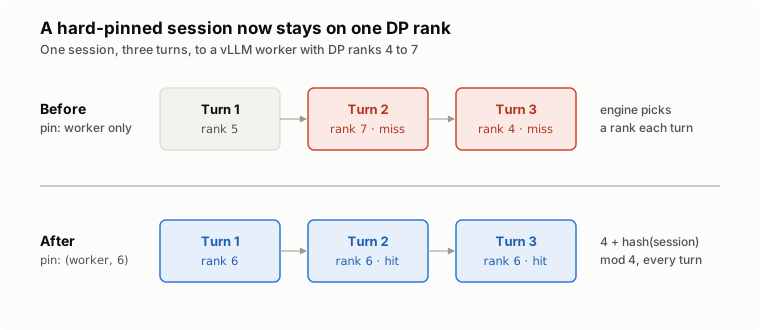
Dynamo promised that a hard-pinned session stays on one worker and, when available, one data-parallel rank. Under KV routing it did. Under round-robin, random and the other built-in policies, only the worker was pinned, so the engine moved each turn to whichever rank it liked.
In short
NVIDIA Dynamo is an open-source serving framework that routes LLM requests across GPU workers. A large model is often served with data parallelism: one worker runs several copies of the model, called DP ranks, and each rank keeps its own prefix cache of recently seen tokens.
For multi-turn chats, Dynamo offers hard session affinity: every turn of a conversation goes to the same place, so the next turn can reuse the cache the last one built. A maintainer reported in issue #17641 that this only held at the worker level for most routing policies. I found the root cause in the Rust router, chose a fix that needed no changes to workers or the wire format, and opened PR #17761: about 45 lines of core logic, three regression tests, and documentation that now says exactly what hard and soft affinity guarantee.
The problem
Dynamo’s router has a KV-aware mode and several built-in policies: round-robin, random, power-of-two choices, least-loaded and device-aware weighted. With KV routing, a hard session binding already stored (worker, rank). With the built-in policies it stored (worker, None).
Every later turn was then dispatched to the right worker with no rank. The vLLM handler passes a missing rank through as “no preference”, so vLLM’s own load balancer picked a rank for each request. The session stayed on one machine but hopped between its model copies, losing the per-rank cache that affinity exists to keep.
I reproduced it before changing anything with a test that ran each built-in policy in hard mode for two turns:
RoundRobin:  pin=RouteTarget { worker_id: …, dp_rank: None }  dispatched dp_ranks=[None, None]
Random:      pin=RouteTarget { worker_id: …, dp_rank: None }  dispatched dp_ranks=[None, None]
LeastLoaded: pin=RouteTarget { worker_id: …, dp_rank: None }  dispatched dp_ranks=[None, None]
Root cause
In routing_host/builtin.rs, the closure that builds the dispatch target, target_for_worker, restored a stored rank only in soft mode. In hard mode it always returned a worker-only target. That target was committed as the session binding after the first successful dispatch, and every later turn read it back and sent dp_rank = None.
The KV path didn’t have the problem because its scheduler always chooses a rank and commits it with the worker.
Choosing a fix
The issue suggested two directions, and I weighed three designs before writing code:
| Option | What it needs | Decision |
|---|---|---|
| Record the rank the engine actually used | A new field in the engine output protocol, handler changes in three backends, and vLLM doesn’t expose which DP engine served a request. The binding is also committed before the first response arrives. | Rejected: 300+ lines, a wire change, and backward-compatibility handling for older workers |
| Let each policy pick the rank | Changes to public selection APIs across three crates | Rejected: 120+ lines, and it would collide with ongoing work to turn built-in policies into plugins |
| Router picks the rank when the binding is created | The router already tracks each worker’s declared DP ranks in its worker monitor; nothing new is needed from workers | Chosen: small, contained to the router, and no wire format change |
I posted the trade-off on the issue before building, and offered the maintainer a load-aware rank pick as an alternative.
The fix
One helper decides the rank for a hard-pinned session (lightly simplified):
fn hard_affinity_dp_rank(&self, worker_id: u64, bound: Option<AffinityTarget>, binding_key: &str) -> Option<u32> {
    // 1. Keep the rank the session is already bound to on this worker.
    if let Some(dp_rank) = bound.filter(|b| b.worker_id == worker_id).and_then(|b| b.dp_rank) {
        return Some(dp_rank);
    }
    // 2. Otherwise pick one from the worker's declared range by hashing the session key.
    let dp_ranks = self.routing_context.as_ref()?.monitor()?.declared_dp_ranks(worker_id)?;
    let dp_size = dp_ranks.len() as u64;
    (dp_size > 1).then(|| dp_ranks.start + (xxh3_64(binding_key.as_bytes()) % dp_size) as u32)
}- Hashing the session ID is deterministic, needs no extra state, and spreads sessions evenly across ranks. Every turn and every router replica computes the same answer.
- Using the declared range (for example ranks 4 to 7) matters. Hard-coding rank 0 would break workers whose ranks don’t start at 0.
- Single-rank workers keep today’s behaviour, so DP=1 traffic is identical on the wire.
- A worker-only hint keeps the bound rank. A design review caught that a later turn naming only the worker would otherwise fail the hard binding’s validation, so the bound rank is merged in, the same way the KV path already does it.
- Older worker-only bindings from older router replicas, or from before the router saw a worker’s config, hash to the same rank on every turn.
The rest of the change is a small accessor on the worker monitor, a getter for the session key, and documentation updates for the router guide and the TensorRT-LLM DP-rank page.
Verification
I wrote the failing test first. On main it failed with “RoundRobin hard pin must include a DP rank”.
| Test | What it checks |
|---|---|
builtin_hard_affinity_pins_declared_dp_rank_for_every_policy |
All five built-in policies, a worker declaring DP ranks 4 to 7, several sessions with three turns each. Every pin is (worker, r) with r in range, every turn dispatches r, and a request without a session still sends no rank. |
builtin_hard_affinity_assigns_rank_to_worker_only_binding |
An existing worker-only binding gets the same hashed rank on every turn. |
builtin_soft_affinity_does_not_pin_declared_dp_rank |
Soft mode is unchanged. |
An independent code review confirmed that removing the worker-only-hint merge makes the main test fail with “bound to DP rank 6, but dispatch did not select a DP rank”. Locally, 492 router tests pass, along with the session-affinity and discovery suites, cargo fmt, clippy and pre-commit.
These are unit tests of the router. They show that it picks, pins and sends the rank. I don’t have a GPU, so an end-to-end run with vLLM at DP>1 is left to upstream CI and maintainers.
What this work shows
- Reading an unfamiliar codebase quickly. I traced a request across the Rust router, the worker discovery monitor and the Python vLLM handler to find the single closure responsible.
- Picking the smallest correct design. I compared three approaches by blast radius, compatibility and conflict with ongoing work, and chose the one that needed no protocol change.
- Test-first, with a failing reproduction. Each test was shown to fail before the fix, and the subtle merge case was confirmed by reverting it.
- Being honest about limits. The PR spells out what was tested locally, what needs a GPU, and the remaining trade-offs: rank choice is load-blind, and an older router replica can still reject a worker-only hint during a rolling upgrade.
- Working with maintainers. I claimed the issue, shared the root cause and trade-off on the thread, and kept the change compatible with the planned plugin refactor.