Open source · vllm-project/aibrix · #3372
Why AIBrix clients got an error status with an empty body
When an upstream error body reached the AIBrix gateway in more than one chunk, the client sometimes got a 400 with no body at all. The issue suggested buffering the chunks and answering once. Running it against real Envoy showed that this would still fail, because by the time the body arrives the response headers have already gone to the client.
Context: a gateway that sits inside Envoy
AIBrix is a control plane for serving LLMs on Kubernetes. Its gateway plugin runs as an Envoy external processor (ext_proc): Envoy streams each request and response to the plugin over gRPC, and the plugin answers each message with mutations or, when something goes wrong, an ImmediateResponse that replaces the reply.
Response bodies are configured in STREAMED mode, so Envoy sends the body to the plugin chunk by chunk as it arrives from the model server. On a non-2xx upstream status the plugin rewrites the body into a single OpenAI-style error envelope. That rewrite happens in the st.isRespError branch of pkg/plugins/gateway/gateway.go.
Symptom: a 400 with nothing in it
Issue #3372 came from a flaky end-to-end test. A prefill/decode pod answered 400, and the gateway logged two request end lines 150 µs apart, the second with an empty message:
"request end" requestID="1979b451-..." errorCode=400 errorMessage=<{"error":{"code":null,"message":"invalid x-aibrix-mock-delay-ms",...}}>
"request end" requestID="1979b451-..." errorCode=400 errorMessage=""
The client then failed with unexpected end of JSON input. Whether Envoy split the error body into two messages depended on timing, which is why the test only failed sometimes.
Root cause: answering every chunk, after the headers had left
The error branch handles each ResponseBody message on its own:
if st.isRespError {
    body := string(req.Request.(*extProcPb.ProcessingRequest_ResponseBody).ResponseBody.GetBody())
    body = string(rewriteVideoJobErrorBody(st.routerCtx, []byte(body)))
    resp = s.responseErrorProcessingWithHeaders(st.ctx, st.routerCtx, st.lastRespHeaders, st.respErrorCode, st.model, st.requestID, body)
}
responseErrorProcessingWithHeaders builds an ImmediateResponse. So a body that arrives as “JSON, then an empty end-of-stream chunk” gets two immediate responses, the second built from an empty string.
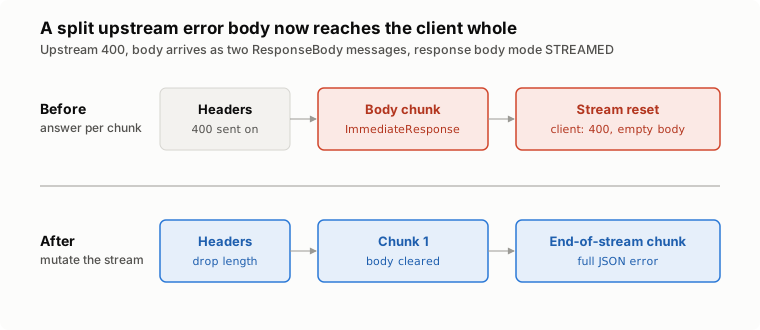
The issue author’s reading was that the duplicate answer was the bug. When I reproduced it against envoyproxy/envoy:v1.33.2 with the response body in STREAMED mode, I found a deeper problem. Envoy forwards the response headers to the client as soon as the external processor answers the headers message, unless the whole body was already buffered. After that point an ImmediateResponse in the body phase cannot replace the reply. All Envoy can do is reset the stream. The client has already seen 400 and gets an empty, truncated body.
Constraints: the suggested fix had the same flaw
The issue proposed two fixes: accumulate the chunks until end_of_stream and normalize once, or handle only the first chunk. Both still answer with an ImmediateResponse during the body phase. In my reproduction, accumulating and then sending one ImmediateResponse still reset the stream. Fixing the double answer alone would have left the client with the same empty body.
So the fix had to stay inside the response that Envoy was already streaming, rather than try to replace it.
Design: rewrite the stream instead of replacing it
What worked in my reproduction used only mutations Envoy can still apply after headers are sent:
- At header time, remove
Content-Length. The normalized error will not be the same length as the upstream body, and a stale length breaks framing. - Clear the body of each non-final chunk. Nothing partial reaches the client.
- On the
end_of_streamchunk, write the complete normalized error throughbody_mutation. The client gets one well-formed JSON error with the original status.
I posted the reproduction, the reason the suggested fix would not work, and this direction on the issue, and asked whether it was acceptable for the isRespError branch before taking it.
Outcome: adopted upstream
The issue author replied that they had reached the same approach and validated it against Envoy 1.33.2 by running the real gateway Server.Process over gRPC. They opened PR #3382, which removes Content-Length at header time, clears intermediate chunks and writes the complete error into the final chunk through BodyMutation, and they credited the reproduction and the stream-reset explanation in the thread. They already had a working patch, so I did not open a competing PR.
What I contributed is the diagnosis: the real-Envoy reproduction, the reason a body-phase ImmediateResponse cannot work once headers are forwarded, and the direction that the fix took. The implementation, its test matrix and the end-to-end run are the PR author’s work.
Core concepts this exercised
- Test against the real proxy, not a model of it. The bug lives in how Envoy treats a late
ImmediateResponse, which a unit test with a fake gRPC stream would not show. Running real Envoy is what exposed it. - Check a suggested fix before building it. The fix in the issue looked reasonable and would have removed the duplicate log line, but the client would still have got an empty body.
- Know what can still change after headers are sent. Once headers are on the wire, only the body stream can be shaped, so the fix had to use body mutations and drop
Content-Lengthearly. - Explain why a test is flaky. The failure depended on whether Envoy happened to split the body, which explains why it only showed up sometimes in CI.
- Coordinate instead of racing. Posting the evidence and asking before building led to one correct fix upstream instead of two competing ones.